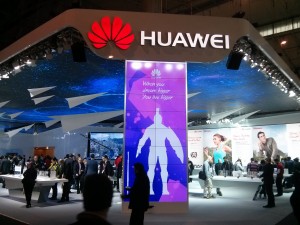
Bottom line: Huawei’s debut notebook PC will get mixed reviews and so-so sales due to its lack of experience, but future models will rapidly improve and propel the company to one of the world’s top 5 brands in the next 2-3 years.
Huawei rolls out MateBook PC
Fast-rising smartphone maker Huawei has formally rolled out its first PC model, and is saying quite boldly that its ultimately target in this new product area is struggling hometown rival Lenovo (HKEx: 992). The move comes a month after media first reported that Huawei would enter the stagnating PC space, where traditional desktop models are rapidly disappearing and even growth for portable notebook models is slowing sharply. (previous post)
The move isn’t a huge surprise, since lines are rapidly blurring between traditional notebook PCs and a newer generation of portable devices led by smartphones. Many large-screen smartphones, often called phablets, and tablet PCs are nearly as large as notebooks and have similar functions. Likewise, a growing number of notebook PCs now have detachable screens that can be used like a tablet PC. Read Full Post…
Bottom line: Lenovo chief Yang Yuanqing is likely to resign or get replaced as company head by the end of this year as sales continue to stumble, possibly by recently named President Gianfranco Lanci from its European operations.
Lenovo looks at tough year ahead
If there’s a single word to summarize the latest quarterly results from struggling PC giant Lenovo (HKEx: 992), it’s “down”. Just about every major metric in its just-released results was down, though the company did manage to boost its net profit for the quarter thanks to recent aggressive cost cutting. But lowering costs isn’t a long-term formula for success, and investors are clearly worried about the prospects for Lenovo’s shriveling core PC business and a sputtering mobile device unit that is supposed to be its new growth driver.
Investors were clearly most spooked by Lenovo’s top line revenue, which shrank 8 percent to $12.9 billion in its latest quarter. That was the first time Lenovo has posted such a revenue decline in more than 6 years, and nicely summarizes the company’s struggles in just about all of its major product areas. Lenovo did achieve one notable milestone as its mobile device unit finally climbed from the loss column to break even. But even that is hardly an accomplishment since cost cutting was most likely the main driver behind that movement. Read Full Post…
Bottom line: Huawei’s new move into notebook PCs could seriously challenge the existing establishment, and it could become a top 5 brand by the end of next year.
Huawei moves into notebook PCs
Telecoms giant Huawei is making a surprise move into the PC market, with word that it will launch a new line of notebook models next month using chips supplied by Intel (Nasdaq: INTC). The move would put Huawei into direct competition with leading PC maker Lenovo (HKEx: 992), as it aggressively expands beyond its older networking equipment business and diversifies into consumer electronics.
Huawei’s move into notebooks isn’t a huge surprise, since such products are increasingly similar to the new generation of smartphones where Huawei has found recent success. Huawei already sells tablet PCs, which perform many of the functions as notebooks as well. But the move does represent an entire new product area for Huawei, and is almost certain to put the company on collision course with Lenovo in their home China market. Read Full Post…
Bottom line: Tsinghua Unigroup could be quietly helping to bankroll Western Digital’s bid for SanDisk, as part of its vision of building a Chinese NAND memory powerhouse that could challenge Samsung.
Unigroup bankrolling Western Digital’s SanDisk bid?
I don’t consider myself a conspiracy theorist, but a sudden flurry of multibillion-dollar memory chip deals all involving Tsinghua Unigroup is certainly catching my attention. Just a day after global chip giant Intel (Nasdaq: INTC) announced a $5.5 billion investment that looked related to Unigroup, we’re seeing yet another similarly large deal that has some indirect ties to this Chinese company linked to the nation’s top science institution, Tsinghua University.
This latest new deal will see hard disk maker Western Digital (Nasdaq: WDC) buy flash memory maker SanDisk (Nasdaq: SNDK) in a cash and stock deal worth $19 billion. (English article; Chinese article) China watchers will recall that announcement of this deal comes just 2 weeks after a Unigroup affiliate paid $3.8 billion for 15 percent of Western Digital. (previous post) I theorized a short time later that Unigroup’s sudden thirst for memory could even prompt it to make a play for storage device giant EMC (NYSE: EMC), which is in the process of being acquired by Dell in a blockbuster deal worth $67 billion. (previous post) Read Full Post…
Bottom line: Lenovo and Tsinghua Unigroup may be considering rival bids for EMC following a $67 billion offer from Dell, but will ultimately abandon any such plans due to high price and political sensitivities.
Unigroup, Lenovo eying rival bids for EMC?
As the blockbuster deal that would see faded PC giant Dell buy leading memory products maker EMC (NYSE: EMC) for $67 billion buzzes through the high-tech headlines, I thought I would look at 2 leading Chinese candidates whose names were noticeably absent on the list of companies that might make rival bids for EMC. China tech watchers will know I’m referring to local PC giant Lenovo (HKEx: 992), which has never seen an acquisition opportunity it didn’t like, and the more recently acquisitive Tsinghua Unigroup.
Both of these names could be interested in EMC for similar reasons, and each could theoretically make rival bid for the US company. Dell’s newly announced purchase of EMC would be one of the biggest-ever sales in the high-tech world, but also includes a 60 day period where others could make counter offers. Other names mentioned that could make such bids include the likes of IBM (NYSE: IBM), Cisco (Nasdaq: CSCO) and Hewlett-Packard (NYSE: HPQ), though sources say the chances of such a bid are slim. Read Full Post…
Bottom line: Cisco’s new joint venture will mostly resell its networking equipment into China, and is unlikely to ease Beijing’s worries that its products could be used by Washington for cyber spying.
Cisco calls on China with new JV
Networking equipment giant Cisco (NYSE: CSCO) has become the latest global tech firm to capitulate to China’s national security paranoia, announcing the formation of a new joint venture with a local partner. The tie-up with Inspur Group is just the latest in a recent string of new China-based partnerships involving big western tech firms. Those companies, whose ranks also include IBM (NYSE: IBM) and Hewlett-Packard (NYSE: HPQ), fear that without such well-connected local partners, they could get locked out of the lucrative IT services market under tough restrictions imposed by a new Chinese national security law.
Announcement of the new joint venture with Inspur marks a major shift for Cisco, which up until now has preferred to do its business in China by itself rather than with a local partner. Cisco’s earlier go-it-alone posture has already come with a high cost it in a country where Beijing prefers to see big foreign tech names transfer technology to local partners. Thus this latest partnership should perhaps help to ease some of that pressure, even though it could ultimately put some of Cisco’s intellectual property at risk. Read Full Post…
Bottom line: Huawei’s new push into IT services could do well due to the company’s strong background in telecoms products, and could see it form a major partnership in the area with a big global player.
IT services tie-up ahead for Huawei?
Networking equipment giant Huawei is continuing its diversification, with word that it’s planning a major push into the market for information technology (IT) services that could put it into direct competition with such giants as IBM (NYSE: IBM) and Hewlett-Packard (NYSE: HPQ). But perhaps more intriguing is the possibility that Huawei could form a major partnership with one of the big foreign names, amid a rise in such pairings due to restrictions on foreign firms under China’s new national security law.
Huawei began its life as a maker of networking equipment for big telecoms carriers, but more recently has tried to diversify as the global market for those products slows. It has pushed into networking equipment for enterprises, and more recently has found growing success with smartphones. But IT services has remained a relatively small portion of the business, expected to reach $2 billion in sales this year. That would be just a tiny portion of the 288 billion yuan, or about $45 billion, that Huawei posted in revenue last year. Read Full Post…
Bottom line: A threat to privatize Baidu by chairman Robin Li is probably the result of frustration at recent declines in the company’s stock and is unlikely to result in a serious buy-out bid.
Frustrated Robin Li threatens Baidu privatization
The biggest privatization threat to date by a US-listed Chinese company has just come from online search leader Baidu (Nasdaq: BIDU), whose chairman Robin Li is joining a growing chorus of executives who say their shares are underappreciated by Wall Street investors. In this case it’s easy to see why Li is unhappy, since Baidu’s stock has lost a quarter of its value since July, when the company reported a spending binge on new businesses had sapped its profits.
Baidu’s shares were actually down by an even greater 30 percent at the start of this week, but surged 6 percent in the latest session amid a broader rally for Chinese Internet stocks. It should come as no surprise that the US surge was sparked by a rally earlier in the day on China’s domestic stock markets, which is where Baidu and many of its other US-listed Internet peers say they would like to re-list. Read Full Post…
Bottom line: Dell’s massive new China commitment could foreshadow a major new tie-up that could see it sell a big stake of itself to a local partner, while Lenovo could be eyeing a major shift to OEM production for its floundering smartphone unit.
Dell bets big on China
Two of the world’s top PC makers are in the China headlines today, with homegrown leader Lenovo (HKEx: 992) and US giant Dell both making major strategic moves. But in a sign of the times, neither item is related to either companies’ core PC business, showing just how quickly personal computers are losing their relevance in the fast-changing gadget world.
Dell’s announcement contains the biggest headline figure, with the company announcing a new commitment to spend a whopping $125 billion in China over the next 5 years. But the Lenovo news is equally intriguing if it’s true, and hints the company could be preparing a major shift for its floundering move into smartphones. That shift would see Lenovo’s smartphone unit build up its business of taking manufacturing orders from third-party brands, a model known contract manufacturing or OEM production. Read Full Post…
The following press releases and media reports about Chinese companies were carried on September 11. To view a full article or story, click on the link next to the headline.
══════════════════════════════════════════════
Dell Says to Invest $125 Bln in China Over 5 Years (English article)
Lenovo (HKEx: 992) Starts OEM Smartphone Production for Other Brands – Report (Chinese article)
Mindray (NYSE: MR) Receives Revised Proposal to Acquire Company at $27 Per ADS (PRNewswire)
Didi Kuaidi Said to Join Alibaba, Tencent in Lyft Funding Deal (English article)
Tencent (HKEx: 700) WeBank Chief Cao Tong Resigns (Chinese article)
Bottom line: Lenovo’s attempt to make Motorola the flagship for its smartphone business looks set to fizzle, in a major setback for the company’s drive into mobile devices.
Moto sales on downward slide
I’ve predicted gloom and doom before for PC giant Lenovo (HKEx: 992), China’s first truly global high-tech brand, and each time the company has proven me wrong. But Lenovo’s latest quarterly financial report really does look like cause for concern once more, showing results that can only be described as terrible. Anchoring the misery was a huge sales plunge for its recently acquired Motorola brand, which was meant to become a cornerstone for Lenovo’s emerging smartphone business.
In some ways this particular cycle looks like deja vu, since Lenovo followed a similar pattern when it burst onto the global stage a decade ago with its landmark purchase of IBM’s (NYSE: IBM) PC business. That acquisition also later created major headaches for Lenovo, and resulted in a massive restructuring that ultimately laid the groundwork for the company to become the world’s leading PC brand. Read Full Post…