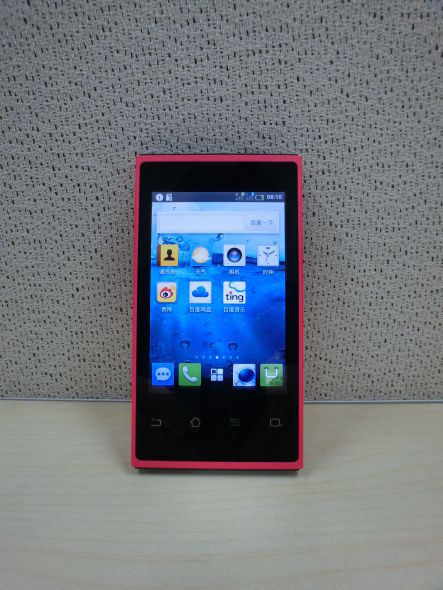
 I don’t like to sound too negative for 2 days in a row, but one day after predicting failure for PC giant Lenovo’s (HKEx: 992) new smart TV initiative I have to give a similar forecast for the recent rush into smartphones by a growing number of Chinese Internet players, with search leader Baidu (Nasdaq: BIDU) leading the charge. Chinese media have been buzzing for the last few days about Baidu’s new offering, a low-end smartphone that runs on the company’s self-developed operating system and was co-developed with TV maker Changhong (Shanghai: 600839). (Chinese article; English article) Baidu’s move follows the announcement of similar self-developed smartphones from online game specialist Shanda and Internet security firm Qihoo 360 (NYSE: QIHU), and the latest reports that online game specialist NetEase (Nasdaq: NTES) may also be getting into the space. (English article) Let’s have a closer look at the Baidu smartphone initiative, as that one is the most advanced, following the previous roll-out of an original Baidu model that failed to gain much attention under a partnership with Dell (Nasdaq: DELL). This latest tie-up with Changhong differs from the Dell model in that it is significantly cheaper, costing just 899 yuan, or about $140. I’ve looked at pictures of the new phone, and while a photo doesn’t always tell the full story, the handset truly does look clunky and cheap. I’m a bit surprised that Baidu is partnering with such unexperienced companies, first with Dell and now Changhong, in this initiative that is no doubt costing a lot of money. Dell is more known for its computers than cellphones, though the 2 product types do share some similarities. Changhong is known almost exclusively for its TVs, which have almost nothing in common with smartphones. That said, I really don’t expect much if any success for this new Baidu-Changhong model, which will have to compete with much more attractive low-cost smartphones from fast-growing domestic firms ZTE (HKEx: 763; Shenzhen: 000063) and Huawei, which mostly use Google’s (Nasdaq: GOOG) popular and reliable Android operating system. In fact, Baidu’s initiative looks like an attempt to imitate Google with Android, acknowledging the increasing importance of the mobile Internet. I applaud Baidu for putting big resources into this important new area, but honestly believe its smartphone initiative is set for failure. If Baidu wants to increase its chances of success, it could start by partnering with a major smartphone maker rather than Changhong, though I suspect many such players would be reluctant to form such a tie-up. Meantime, I would make similar predictions for the other smartphone initiatives from Shanda, Qihoo and now NetEase. I’m not sure why all these companies are taking such steps, as the smartphone market is already quite crowded with much more experienced and resource-rich players like Apple (Nasdaq: AAPL) and Samsung (Seoul: 005930). Perhaps all these companies just have too much money and are looking for a place to spend it.
Bottom line: Baidu’s smartphone initiative is likely to fail due to competition and inexperience, but could stand a better chance of success with better manufacturing partners.
Related postings 相关文章:
◙ Huawei Follows ZTE to Lower Profits 继中兴之后华为利润也降低
 I should credit leading PC maker Lenovo (HKEx: 992) for being ahead of the curve by releasing its new smart TV in China last week, getting a slight lead on a widely anticipated launch for by Apple (Nasdaq: AAPL) for a similar new product group that could revolutionize the way people watch TV. (
 There’s an interesting story out today saying that fading Japanese electronics giant Sharp (Tokyo: 3128) is exploring the possibility of a cellphone tie-up with Taiwan’s Foxconn (HKEx: 2038), the latest wrinkle in a story that is seeing a growing number of Japanese firms hand over many of their struggling consumer electronics to Chinese firms that specialize in low-cost manufacturing. The latest media reports indicate that talks are very preliminary, saying only that top executives from Foxconn and Sharp met in Beijing this week to discuss such a tie-up. (
 The latest noise coming from the high-profile trademark dispute over the iPad name doesn’t look too good for Apple (Nasdaq: AAPL), whose assertion that it legally owns the iPad name in China is being undermined by comments from one of the few government officials to comment on the matter. I wouldn’t read too much into the comments, as China often engages in this kind of media-based debate to gauge public sentiment on less sensitive commercial issue. Still, the fact that a government official is making comments that appear to favor the plaintiff in the matter, in this case a near-bankrupt company called Proview, indicate that a ruling against Apple is a distinct possibility. Then again, the comments could also be a quiet pressure tactic to get Apple to negotiate, which it has reportedly been reluctant to do as it believes it will win the case and doesn’t want to appear to be getting blackmailed. Let’s look at the actual comments, which have a senior official from the State Administration for Industry and Commerce saying that Proview is the legal registrant of the iPad name in China. (
 What do Venezuela and the tiny island nation of Saint Maarten have that China doesn’t? Starting on Friday, the answer will be the latest iPad, as Apple (Nasdaq: AAPL) has just released the latest list of countries where its newest must-have product will go on sale and China is noticeably absent. Many observers might say that Apple is taking a cautious approach to China pending the resolution of a trademark dispute with a near-bankrupt company over the iPad name in the market. But in my view, the exclusion of China from the list is just as much about applying pressure on Beijing for a court ruling in its favor, and says more broadly that Apple could withhold its popular products in the future if it doesn’t believe it is being treated fairly in the market. After all, withholding Apple products could easily anger many Chinese consumers eager to have the latest hot product, perhaps prompting them to hold Beijing responsible. Furthermore, the absence of legally imported iPads will fuel a surge in smuggled products, costing China millions of dollars in lost import duties. But let’s take a look at the specific situation to put things in perspective. Apple announced the launch of its newest iPad on March 7, and the tablet PC went on sale about a week later in the US and several global markets, including Japan, Hong Kong and Singapore in Asia. Another group of countries, mostly in Europe, joined the list about a week later, as sales surged to more than 3 million just 3 days after the initial launch. Now Apple has just announced a third group of countries that will receive the new iPad starting April 20, including the likes of tiny markets like Saint Maarten and Venezuela. (
 After pronouncing last year that TCL Communication (HKEx: 2618) had successfully completed a turnaround for its cellphone business that nearly bankrupted the company 6 years ago, it seems I need to update my view on this cyclical firm where history is now repeating itself. The cellphone making sister company of leading Chinese TV maker TCL Multimedia (HKEx: 1070) issued an ominous warning late last week, saying its first-quarter profit would be “significantly lower” that the previous year. (
 I was highly skeptical at first about a rumor that Google (Nasdaq: GOOG) might be in talks to sell its Motorola Mobility (NYSE: MMI) handset business to telecoms equipment and cellphone giant Huawei; but the more I think about it the more it makes sense, leading me to speculate that the rumor may actually be true. The source of all the buzz is actually quite small, namely a small mention at the very end of a